
Reading and Phonics Scheme Overview

  1. Rationale and Intent

At Walton-le-Dale High School, students arrive with a wide variety of reading abilities. To target support effectively, the school uses baseline assessments to identify whether students require further reading support and decide on a suitable intervention pathway to support this. In addition, all students are provided with access to high quality reading material during form time in years 7-10.  In addition, students at KS3 have a dedicated library lesson each week, to further develop reading skills and foster a love of reading.

Our aim is for all students to have access to high-quality, diverse, and thought-provoking texts throughout their time at Walton-le-Dale High School. It is our goal for staff and students to share the joy of reading these texts together, discussing their themes, issues, and language, making reading a pleasure for everyone.
  1. Core Reading Programmes

To build competent and confident readers, the school splits intervention and practice into three streamlined strategies:

  • Little Wandle Code: an all-in-one phonics assessment and intervention programme designed specifically for Key Stage 3 students (ages 11–14) who enter secondary school without the necessary decoding and fluency skills. The programme is split into specific pathways to build students’ phonic knowledge and confidence using age-appropriate materials developed with ⁠Collins and the ⁠Fisher Family Trust (FFT).
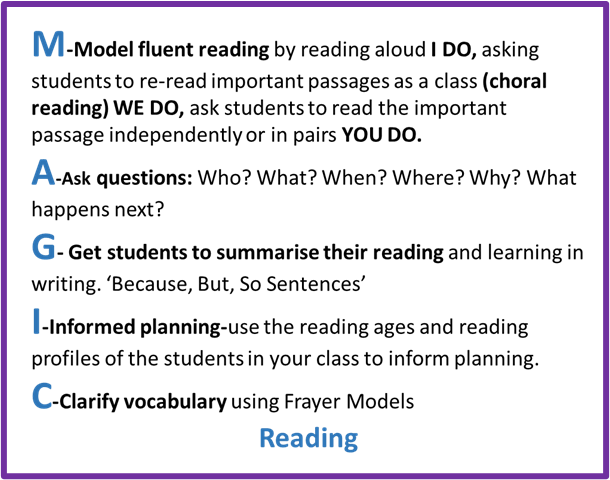
  • Form Time Reading: Dedicated form time sessions are used to develop students’ reading skills. These sessions utilise the school’s MAGIC Reading (please see below) to structure the session and ensure that evidence based strategies are used to explicitly teach reading fluency and comprehension.
  • Weekly Library Lesson: At KS3 studenst have one dedicated libaray lesson where reading in smaller groups and independent reading can take place. Reciprocal Reading groups can be used to develop reading comprehension skills, alongside explicit teaching of punctuation and grammar through reading.  Reciprocal reading is a structured approach to teaching strategies (questioning, clarifying, summarising and predicting) that students can use to improve their reading comprehension.  Rated as having high impact in the Education Endowment Foundation (EEF) Toolkit, it helps pupils who can decode text accurately but struggle to understand its meaning, helping students to make 2+ months reading progress.
  1. MAGIC Reading

At Walton-le-Dale High School we have created a daily reading framework to support the explicit teaching of reading, both as part of quality first teaching and to inform intervention and approaches used during dedicated reading time (form and during library lessons).  This framework utilises evidence-based strategies to explicitly teach reading fluency and comprehension.  All staff have access to students reading ages on Synergy and plan and adapt lessons accordingly.  The MAGIC Reading framework can be found below:


  1. Vocabulary and Assessment

Vocabulary Development: Teachers systematically read ahead in the text to identify challenging words. Unfamiliar vocabulary is explicitly pre-taught to students using the structured Frayer Model framework where necessary.

Formative Assessments: Booklets with activities to support the MAGIC Reading framework are used during form time reading and support teachers in assessing students reading skills.

Little Wandle Assessment: The assessment framework guides teachers through a structured journey to identify struggling readers and track their progress.

  • Initial Cohort Screen: A baseline assessment evaluates students to pinpoint those who lack necessary decoding skills and require immediate intervention.
  • Diagnostic Assessments: For students identified as struggling, diagnostic tools isolate specific gaps in their phonic knowledge, ensuring interventions are perfectly tailored to their needs.
  • Ongoing & Summative Assessments: Regular progress monitoring checks track how well students are mastering new grapheme-phoneme correspondences (GPCs) and vocabulary.
  • “You as a Reader” Report: This unique reporting feature helps students build self-esteem by highlighting their reading journey, progress, and developing skills.
  • Assessment Tracker: All half-termly and intervention progress data can be logged using the Little Wandle Assessments Tracker to easily share progress and plan your next teaching steps.
  1. Holistic Personal Development (SMSC & FBV)

The reading curriculum is intentionally mapped to drive broader spiritual, moral, social, and cultural (SMSC) development alongside Fundamental British Values (FBV):

  • SMSC Integration: Diverse themes prompt reflection on personal beliefs, empathy for others’ feelings, recognition of right vs. wrong, appreciation of social diversity, and understanding cultural heritage.
  • Fundamental British Values (FBV): Discussions around texts help embed a mutual respect for differing faiths, individual liberty, civil law, and combatting discrimination while reinforcing self-esteem.
  1. Sample Curriculum Literature Showcase

The scheme introduces high-quality, impactful literature across the year groups to challenge and engage students:

  • “The Boy at the Back of the Class” by Onjali Q. Rauf — Offers a child’s perspective on the refugee crisis, emphasizing friendship and kindness.
  • “Can You See Me?” by L. Scott & R. Westcott — A coming-of-age story celebrating individual differences and navigating school with autism.
  • “Armistice Runner” by Tom Palmer — Weaves historical bravery from WWI diaries with modern fell-running and Alzheimer’s awareness.
  • “Wonder” by R.J. Palacio — Explores empathy, facial disfigurement, and overcoming cruelty born from ignorance.
  • “Life of Pi” by Yann Martel — A fantasy adventure exploring issues of survival, spirituality, and practicality.
  • “The Curious Incident of the Dog…” by Mark Haddon — A unique first-person detective tale told from the perspective of a teenager with Autism.
Google Maps